Title:** What I Found After the Funeral
I thought burying my husband would be the hardest thing I’d ever endure. Then, eleven days after the funeral, I found something he’d hidden in the garage. Suddenly, grief wasn’t the only thing waiting for me inside this house.
I learned that my husband’s death wasn’t the random accident everyone claimed. And his sister helped hide the truth.
Jack died eleven days ago.
I still hate writing that. The words feel unreal, even though I stood there and watched them lower his coffin into the ground.
Since then, I’ve survived on routine. The children still need breakfast, clean socks, and help with spelling. Only when they’re occupied do I disappear somewhere private and fall apart. The laundry room. The shower. The garage. Anywhere with a lock on the door.
The house is frozen. His boots by the back door. His jacket over the chair. His coffee mug still in the dish rack because I can’t bring myself to wash it.
And Karen. She’s everywhere.
Jack’s older sister has stayed close since he died. Casseroles. Constant check-ins on the kids. At the service, she squeezed my hand so tightly I thought she might be the only person there who truly understood what had happened to me.
But she also kept saying one thing: “Don’t start sorting through Jack’s work things yet. Let the company handle the paperwork first.”
At the time, that sounded sensible. Now it sounds like a threat.
Two days after the funeral, Nolan showed up. He introduced himself as Human Resources, but his card read *Director of Employee Relations and Risk Management*. He brought a fruit basket and a neatly organized folder of forms.
Sitting at my kitchen table, he said, “I know this is overwhelming. These documents release immediate benefits, accidental death compensation, and support for your children.”
But they weren’t just benefits. It was a settlement agreement. If I signed, I’d accept the company’s version of Jack’s death as a workplace accident, waive certain legal claims, and agree not to disclose any company materials related to his employment.
He slid a pen across the table toward me.
Karen stood by the sink and said softly, “Lisa, this is probably for the best.”
Something went cold inside me.
“I need more time,” I said.
Nolan smiled a rehearsed smile. “There are deadlines.”
After they left, I went into the garage. Not because I was ready to sort through Jack’s things. I just had this terrible feeling he’d left something unfinished—and I was the only one who hadn’t realized it yet.
At the bottom of his toolbox, connected to a small battery pack, I found one of his old backup phones. That nearly broke me. It was such a Jack thing: quiet, practical, prepared.
I powered it on.
There was only one recent video.
I opened it.
The camera looked like it had been propped high on a garage shelf. Jack stood by his workbench. Beneath his hand lay a thick cream-colored envelope stamped with the factory logo.
Then Karen walked into view.
I stopped breathing.
She didn’t look grieving. She looked cornered.
“Jack,” she said, “give me the drive.”
“It’s not yours,” he replied.
“It has my name on it.”
“It has everyone’s name on it.”
Karen stepped closer. “I only signed what they put in front of me.”
Jack’s voice hardened. “You signed maintenance sheets for machines that hadn’t been inspected in months. You signed off on parts that never arrived. You let them keep running line seven because shutting it down would cost too much.”
Karen’s expression shifted. Not guilt. Fear.
“You don’t understand what they’ll do if this gets out.”
“I understand exactly why you came here at midnight,” Jack said.
She reached for the envelope. He pulled it away.
Then Jack said, “Lisa thinks I’m leaving early tomorrow to cover a shift. I’m not. I’m meeting Miriam at the state office at eight. Nolan forced his way into the meeting, but Miriam set it up through official channels. Once I’m there, I’m safe.”
That sentence haunts me now. He wasn’t walking into danger blindly. He believed the meeting itself would protect him. He didn’t know Nolan already knew the time and route.
Karen whispered, “Then don’t go tomorrow.”
Jack studied her. “What did you hear?”
She shook her head quickly. “Nothing. I heard nothing.” But she was already backing away. Then she left.
Jack stepped closer to the camera and leaned in. He looked exhausted.
“Lisa,” he said, “the envelope in the garage is the house copy. It’s not the real copy. Look where Melissa hides her birthday cards. Tuesday is the day. If I don’t come home, call Miriam. Do not sign anything from Nolan.”
Then the screen went black.
Tuesday was the day of the meeting. The day he died.
I walked upstairs so quietly I could hear my own heartbeat. Melissa was asleep, curled around the stuffed rabbit Jack won for her at the county fair. I reached for the shoebox where she kept all his birthday letters.
Under the cards, taped to the bottom, was a silver flash drive.
Tuesday.
I plugged it into my laptop. Folders appeared: photographs, scanned reports, purchase orders, voice recordings, and one document labeled *IF LISA OPENS THIS*. Some of it was chaotic. Blurry pictures. Static-filled audio. Mislabeled folders. You could feel how fast he’d been working.
But the story was unmistakable. Line seven at the factory had been running on patched equipment and falsified inspections. Replacement machinery had been billed but never delivered. Workers had already been hurt. Jack started documenting everything once he realized this wasn’t negligence—it was deliberate.
Karen had been promoted into compliance around that time. Her job was to expose safety failures. Instead, she erased them from official reports.
At the bottom, Jack wrote: *Miriam has the rest. Together it proves intent.*
I returned to the garage. The envelope from the video was gone. That frightened me more than anything. Someone had searched Jack’s belongings after his death.
Under a tray of screws, I found a business card taped flat against the toolbox: *Miriam – State Industrial Safety Review Board*. On the back, Jack had written: *She can take it to investigators if I can’t.*
The next morning, I refused to use the house phone. Karen had been pushing too hard. Nolan appeared too quickly. And the missing envelope proved someone else already knew where to search.
I drove to the grocery store—the only nearby place with a working pay phone. Jack had used it once during an outage.
Miriam answered on the second ring.
“My name is Lisa,” I said. “I’m Jack’s wife.”
She went quiet. Then: “Did he leave you the Tuesday file?”
“Yes.”
Her voice sharpened. “Listen carefully. Nolan will pressure you to sign. That paperwork accepts the company’s version of Jack’s death, limits your claims, and helps bury everything Jack preserved. Do not sign it.”
A black sedan rolled slowly through the parking lot. Karen was driving.
Later, I realized she’d followed me. She wanted me to know she was still watching.
I drove straight to Miriam’s office. She already had copies Jack had given her before the meeting. Her agency was state-run—they investigated workplace safety violations and could refer criminal matters for prosecution. Once she matched her evidence with Jack’s flash drive, the picture became terrifyingly clear.
False inspection records. Missing equipment. Internal messages about how to avoid shutdown optics. One audio clip of Nolan saying, “Jack can be handled internally before he escalates this outside.”
“What does that mean?” I asked.
“It means your husband became a liability,” Miriam said.
I told her I wanted Karen officially on record. Miriam advised against it—she said it could compromise the investigation and put me in danger.
I did it anyway.
Grief had made me reckless in one very specific way. But not careless. Before calling Karen, I copied every file into Miriam’s system, emailed the video to an investigator she trusted, and took the prepaid phone she gave me.
When I called Karen, I said, “I’m scared. I need to understand what Jack pulled us into.”
She heard weakness—because that’s what she expected.
She agreed to come over.
Miriam waited two streets away. I texted her: *If I don’t call by ten, send police.*
Karen entered the garage alone. The moment the door closed, she said, “You should have signed.”
I had my phone recording inside my coat pocket. “I have the video, Karen. I have Jack’s files. I know about line seven.”
She froze.
Then I asked, “Did you know Jack was in danger?”
She stared at me for a long moment. “I knew he was pushing men who don’t like being pushed.”
“That’s not an answer.”
“I told him not to go.”
“Because of Nolan?”
“Because once this left the building, it stopped being a safety problem and became a liability problem.”
“My husband is dead,” I said. “Stop speaking like a corporate memo.”
That broke her.
“I falsified reports,” she admitted. “I signed things I never should have. I convinced myself I was protecting jobs. Then Jack started keeping records. Nolan panicked. The executives above him panicked. I knew they were watching him.”
“And you still helped them.”
“I thought I could contain it.”
“Contain what?”
“The inspections. The complaints. The reason Jack had become a target.”
There it was. Karen hadn’t orchestrated his death. But she helped bury the reason he became vulnerable.
I asked quietly, “What happened that morning?”
She shook her head. “I don’t know exactly. Nolan called afterward. He said there’d been an accident before Jack reached the state office. He said if I talked, I’d go down with everyone else.”
“So you came into my house,” I said. “You held my hand. You told me to sign.”
She began crying. “I was sorry.”
“No,” I said. “You were scared.”
Then I walked away.
I sent Miriam the recording before I even opened her car door. By the time I climbed inside, she was already contacting investigators.
By the next morning, they had enough for emergency action. The factory was searched. Line seven was shut down. Nolan disappeared for several hours before authorities found him at his brother’s cabin.
Within days, Karen was charged with falsifying compliance reports and obstruction. Later, investigators told me the missing envelope had been found half-shredded in a secure disposal bin linked to Nolan’s office.
So now I know. Karen didn’t take it. Nolan did.
The investigation into Jack’s death is still ongoing. Authorities haven’t told me exactly how he died, but they’ve officially ruled out a simple accident.
That matters.
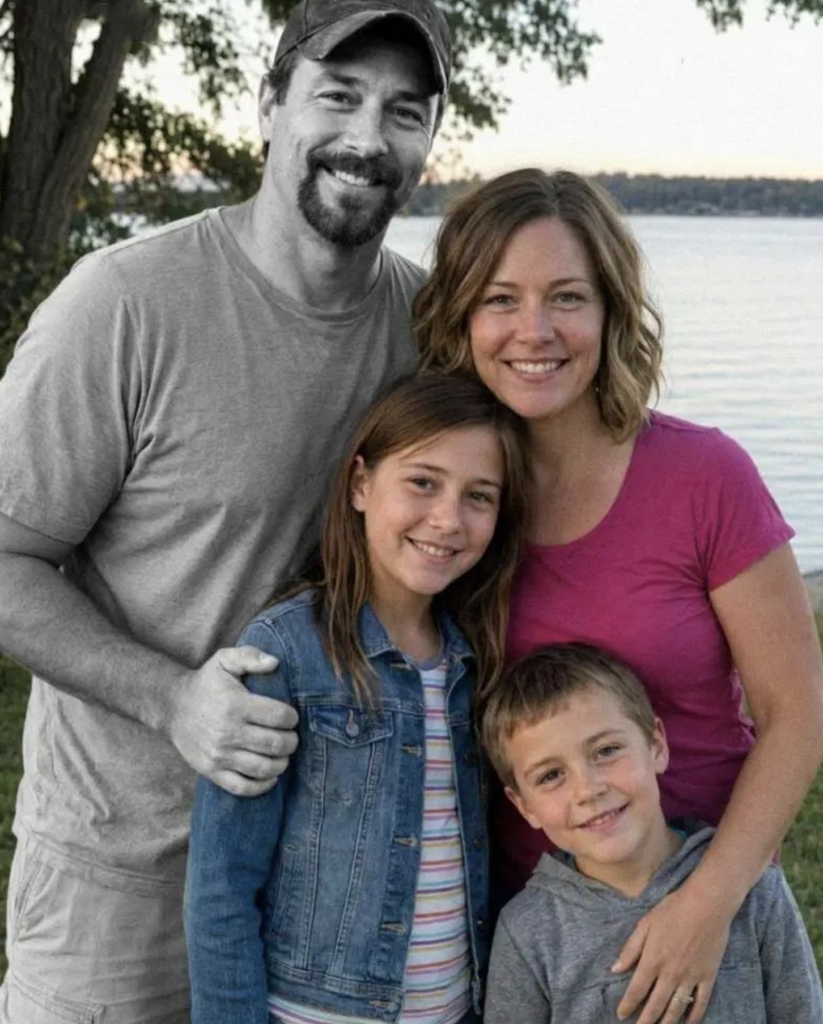
The hardest part has been the children.
Melissa asked me, “Is Aunt Karen bad?”
I told her, “She made bad choices because she was afraid.”
David asked, “Did Dad know?”
I said, “I think he knew enough to leave us the truth.”
Last night, Miriam brought me one final thing from Jack’s locker: a folded note. One sentence.
*If you’re reading this, you were braver than I ever wanted you to have to be.*
I sat on the kitchen floor crying until my chest hurt.
So that’s where I am now. Widow. Mother. Witness.
And the thought I can’t stop returning to is this: Karen held my hand at the funeral because she understood exactly what had been placed in mine.
She just understood it before I did.